Your best deals close when your best product expert is in the room.
That is not a sales strategy. It is a bottleneck.
For many B2B companies selling complex products, the problem is not a weak sales effort or a lack of content. The problem is that product expertise does not scale. It transfers slowly, unevenly, and usually one person at a time.
Sales teams grow. Distributor networks expand. Product portfolios become more advanced. But the real knowledge still sits with a small number of senior specialists, application engineers, product managers, or technical sales experts.
When they are involved, buyers understand the value. When they are not, deals slow down, reps avoid the harder product story, and buyers compare on price instead of performance.
That is why a new category is needed: the embedded AI product expert.
Product complexity has become a sales liability
Complex products should be a competitive advantage. In reality, they often become difficult to sell.
Industrial machinery, automation systems, medtech devices, marine technology, and specialized equipment often carry value that is not obvious from a brochure, slide deck, video, or static 3D model. The buyer needs to understand how the product behaves, how it fits their environment, why it is different, and what it means for cost, performance, risk, or productivity.
Static sales materials can support that conversation, but they cannot lead it. They cannot respond to a buyer’s real question. They cannot adjust to different stakeholders. They cannot show the product working in context.
That creates a familiar pattern:
- Sales leaders see deals stall because buyers do not understand the full value.
- Marketing teams create launch content, but engagement fades quickly, and buyer insight remains limited.
- Sales enablement teams build libraries of assets, but reps still say they have nothing useful to show.
The root cause is the same: product expertise is trapped inside people and static content.
What is an embedded AI product expert?
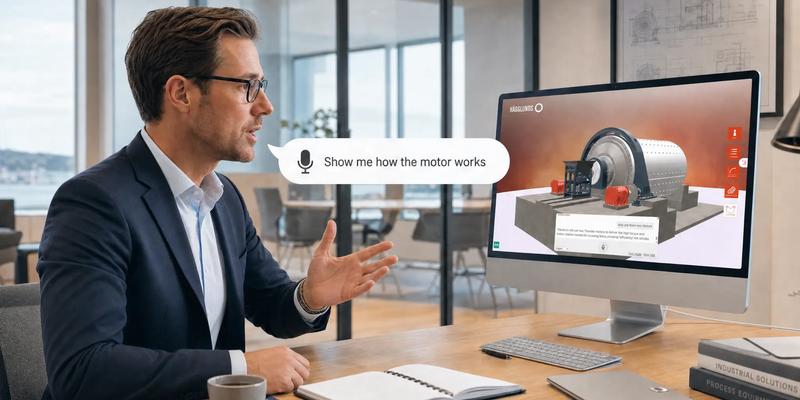
An embedded AI product expert is a digital version of your best product expert, built directly into an interactive product experience.
It is available at any time, in any language, to any buyer, sales rep, distributor, or internal stakeholder who needs to understand the product.
But the word “embedded” matters.
This is not an AI chatbot sitting beside a product page. It is not a generic assistant answering questions from a knowledge base. An embedded AI product expert lives inside the product experience. It can guide the user, control the product simulation, demonstrate functions, explain value, and adapt the conversation based on what the user is trying to understand.
The buyer does not just get an answer. They get a product experience and understand the product's true value.
Why is this different from generic AI
Generic AI can answer questions about a product. An embedded AI product expert can show how the product works. That distinction is not mainly technical. It is commercial.
A buyer rarely asks the perfect question. They ask things like:
- “Why is this better than the cheaper alternative?”
- “How would this work for us?”
- “What would my team actually need to do?”
- “Why should I trust this?”
A generic AI waits for the right question. An embedded AI product expert meets the buyer where they are and guides them forward, even when their question is vague, incomplete, or based on a misunderstanding. That is how real product understanding is built.
Where embedded AI product experts create commercial value
The first, most obvious use case is distributor and partner enablement. Many manufacturers rely on partners across different regions, languages, and levels of technical maturity. Training every distributor perfectly is almost impossible. An embedded AI product expert gives every partner access to the same product story, the same technical logic, and the same guided explanations.
The second use case is sales meetings. A sales rep can share the experience before or after a meeting. A CFO can explore the total cost of ownership. An operations leader can look at installation complexity. A procurement manager can ask about lead times or specifications. The next meeting starts from a higher level of understanding.
The third use case is trade fairs. Booth staff can only handle one conversation at a time. An embedded AI product expert lets more visitors engage with the product, ask questions, and leave behind useful behavioral data. Follow-up becomes specific because the team knows what each visitor actually explored.
Start with one product, one use case, one KPI
The right way to adopt an embedded AI product expert is not to start with a full global rollout. Start narrow. Choose one product where buyer understanding has a clear commercial impact. Select one use case, such as distributor enablement, sales meetings, or a trade fair. Define one KPI, such as sales cycle length, win rate, lead quality, engagement time, or reduction in specialist involvement.
Then prove it. This matters because the embedded AI product expert should not be treated as a technology experiment. It should be treated as a commercial proof project.
A new tool category for complex B2B sales
The B2B sales stack has tools for CRM, enablement, content management, marketing automation, and analytics. But companies selling complex products still have a gap. They need a way to scale product expertise itself.
That is the role of the embedded AI product expert. It helps sales teams explain more clearly, helps buyers understand more deeply, helps distributors sell more consistently, and helps marketing teams see what buyers actually care about.
For companies whose products are difficult to explain but valuable when understood, this may become one of the most important new categories in the sales stack.
The question is simple:
Which product in your portfolio would create the biggest commercial impact if it could explain itself?
Learn more about embedded AI product experts.