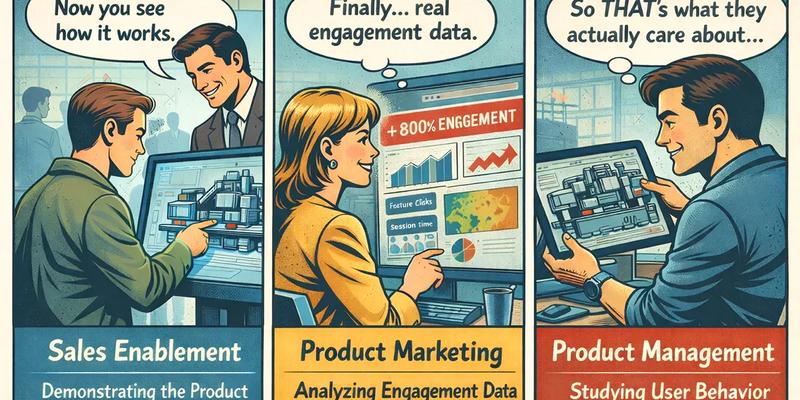
How Sales Enablement, Product Marketing, and Product Management can align to make trade fair results measurable.
Industrial trade fairs remain one of the largest recurring investments in sales and marketing for machinery and automation companies.
- Objectives are defined
- Budgets are allocated long in advance
- Booth concepts are carefully planned
- Machines are transported across borders
- Teams are mobilized for a few intensive days
And yet, when reporting season arrives, evaluation often comes down to lead counts and general impressions.
The issue is rarely the stand design itself. It is how the event is structured, measured, and connected across teams.
Trade fair performance sits at the intersection of Sales Enablement, Product Marketing, and Product Management. When these functions operate with different objectives and limited shared instrumentation, even a well-executed booth struggles to produce a defensible ROI.
A practical way to address this is to align these teams around a shared toolset: a measurable digital product experience.
Sales Enablement: Improving Conversation Quality Without Increasing Staffing
Anyone who has staffed a booth recognizes the constraint. During peak hours the stand is busy, but sales capacity is fixed. A representative can handle one meaningful conversation at a time. Others browse briefly and leave.
At the same time, messaging varies across individuals and regions. That variation is often invisible during the event, yet it becomes clear in follow-up quality.
An interactive digital product experience addresses these realities in practical ways:
- Visitors can engage immediately without waiting for staff
- Sales representatives enter conversations at a more advanced stage
- The explanation follows a consistent structure, regardless of who is presenting
- Junior team members gain confidence when demonstrating complex solutions
Imagine a large component manufacturer exhibiting at an automation trade fair. Instead of only showing physical components on shelves, the company places several touch screens around the booth. Visitors can explore interactive simulations of how the components work inside real OEM machines.
A visitor approaches one of the screens and begins exploring a simulated production line where the company's components are integrated. They open animations, explore system modules, and see how performance changes under different conditions. Sales representatives use the same experience during conversations, guiding visitors through the simulation and showing how the component creates value in the overall system. In some cases visitors can even interact with simple ROI calculators to visualize operational benefits.
Behind the scenes the system measures how visitors explore the product experience. It records which parts attract attention, where people spend time, and which topics trigger deeper exploration. Visitors can request more information, book a meeting, or share the experience with colleagues who were not at the trade fair.
When the company follows up after the event, the sales team already knows what interested each visitor. Instead of starting from scratch, they begin the conversation from the topics the visitor explored in the booth.
This is not about replacing human interaction. It is about scaling it.
Product Marketing: Moving From Lead Volume to Engagement Depth
While Sales Enablement focuses on improving the quality of conversations during the event, Product Marketing often faces the more difficult question afterwards: did the investment actually deliver value?
Lead volume alone rarely provides a convincing answer.
What is typically missing is visibility into engagement quality:
- Which product areas attracted the most interest
- Where visitors spent meaningful time
- What triggered the lead capture
- Which features were overlooked entirely
Most industrial booths still rely on physical equipment, static displays, and looping videos. These elements create presence but provide limited behavioral insight. They also have short life cycles, and once the event ends, much of the investment becomes inactive.
Interactive digital product experiences introduce measurable behavior into the equation. Visitors explore rather than passively observe. Engagement time increases. Lead capture can be integrated naturally into the flow.
Most importantly, the asset does not expire when the fair ends. It can be reused:
- Embedded on the company website
- Shared with distributors and partners
- Integrated into sales meetings
- Used in onboarding and training
The trade fair investment then becomes part of an ongoing marketing infrastructure rather than a standalone event cost.
Product Management: Turning Booth Interactions Into Structured Insight
Beyond sales conversations and marketing reporting, trade fairs can also reveal something valuable for Product Management: how clearly the product itself is understood.
Features may be misunderstood. Differentiation may not be clear. Complex workflows may require more context than a static explanation can provide.
Traditionally, these observations remain anecdotal.
When product experiences are measurable, engagement patterns provide structured insight. Teams can identify:
- Which features attract attention first
- Where visitors hesitate or disengage
- Which workflows resonate most clearly
- What prompts deeper exploration
This complements qualitative feedback from sales teams and customers. It also strengthens roadmap discussions with observable data rather than relying solely on memory and interpretation.
A More Measurable Approach to Trade Fairs
Trade fairs will continue to play a central role in industrial markets. The question is not whether to participate, but how to structure participation more effectively.
If engagement cannot be quantified beyond badge scans, if messaging varies by representative, and if booth assets cannot be reused across channels, the organization is operating with limited feedback loops.
In practice, this affects three functions at once: sales teams struggle to scale conversations, marketing teams lack visibility into engagement, and product teams miss insight into how their solutions are actually understood.
Introducing structured, interactive digital product experiences is less about technology and more about instrumentation. It connects sales execution, marketing accountability, and product clarity into a single, measurable framework.
When trade fairs are treated as measurable growth systems rather than isolated events, short-term presence can translate into long-term commercial impact.